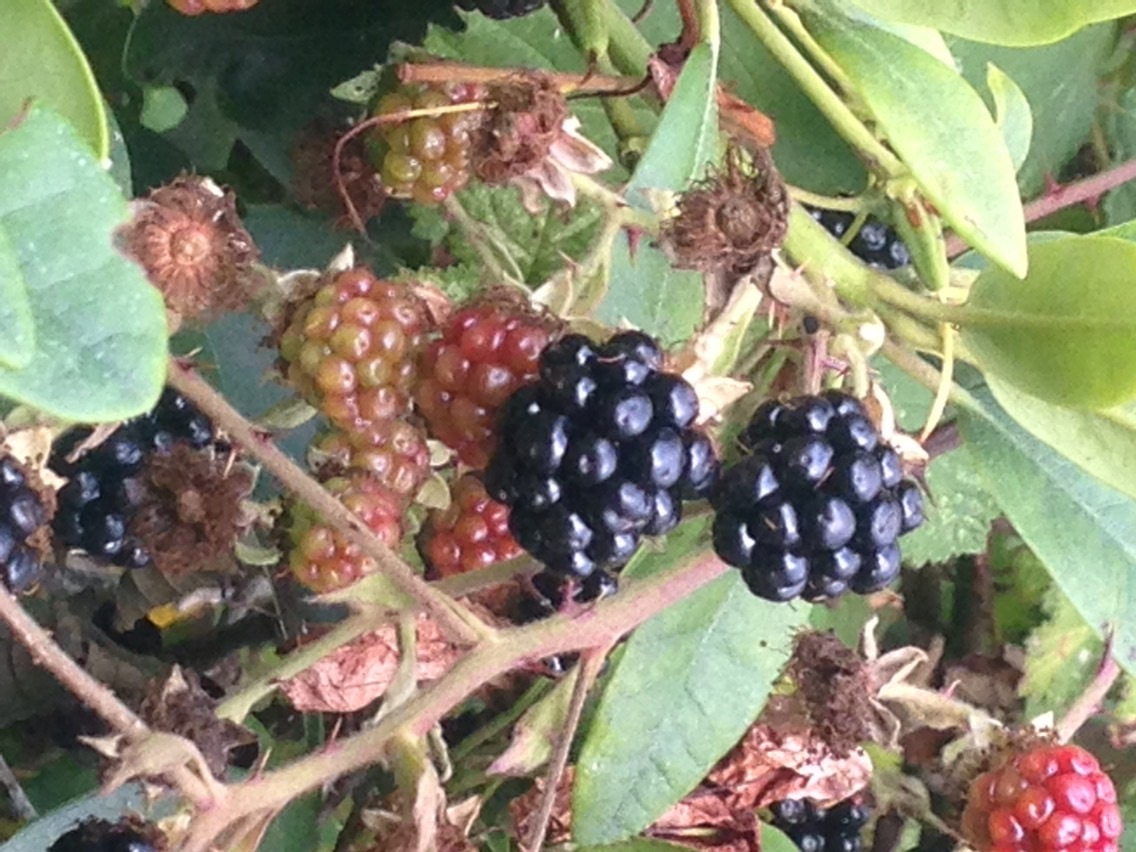
Blackberries are here. Plump, juicy, syrupy sweet, blackberries. Blackberries are one of most desired summer treats in our home on the northern Oregon coast. Not only are they delicious, but since they grow in such abundance, they are literally free to the picking. In fact, I already have two pints in the freezer. Blackberries are just another blessing we receive from this particular, beautiful place we get to live.
However, blackberries have their flaws. I was reflecting on this the other day as I was laboring in the hot sun in my yard. My yard. My yard is a filled with all kinds beautiful flowering plants: Calla lilies, irises, hydrangeas, and many rhododendrons. Then there are the not so desirable plants. I would almost call them evil plants. They are literally killers. Some are invasive, like creeping ivy. Some are amazingly, self-propagating, such as laurel. Others have a very strong symbiotic relationships with birds, such as holly. All of these plants grow unbidden, almost secretly under the cover of other plants. Often by the time you realize they are there they have successfully imbedded themselves into the soil, and around a beloved shrub–nearly chocking the plant of nutrients and sun. I have declared war on these enemies of my yard.
Not so the blackberry. No, the blackberry is complicated. On one hand, I don’t particularly want it all over my yard. But, on the other hand, the ugly bramble produces that delicious berry. I have to weigh whether I have a greater desire to rid myself of the weed, or whether I want to enjoy the fruit of that weed for a season. What is a girl to do?
In situations like this it is helpful to understand the nature of my foe. Blackberries are native to many climate types, including the Northwest. No one has to plant blackberries, they just grow. In fact, it is not advisable to plant blackberries. Blackberries are perennials that can grow roots three and half feet deep. They can grow as tall as 29 feet. It is no wonder that blackberries are often called bramble. Bramble is defined as an impenetrable thicket. Not something you want on your front lawn.
As if its incredible ability to grow were not bad enough, blackberry plants have shoots with prickles. Every rose has its thorn, and every blackberry has a hundred prickles. Don’t be fooled by the cute name, prickles can penetrate denim. I have yet to successfully avoid being prickled by blackberry while pruning or picking them. These prickles often becomes splinters. Of course, these prickly weeds whose super power is growing, can quickly starve other plants. The result of leaving blackberries unattended is death to all the plants within its grasp.
Perhaps now you understand my dilemma. If I let them grow, then they will continue to wreck havoc and mayhem on my yard plants. However, if I attempt to eradicate them, then I will miss out on the many berries that have yet to ripen.
Blackberries reflect the nature of sin. You see sin comes naturally for us fallen creations of God. After punishing the unbelieving through a world-wide flood (a flood that those unbelievers were forewarned of for 100 years!), God said to Abraham, “I will not again curse the ground any more for man’s sake; for the imagination of man’s heart is evil from his youth . . . ” (Genesis 8:21). Sin grows rampant in our hearts from our birth. This gives sin the ability to plant deep roots, and grow tall shoots. These shoots then bend over and plant more roots. The stolen cookie must be lied about, repeatedly.
Sin also grows from seeds plants by others: An abandoned child often develops insecurity. Insecurity can lead to a whole suitcase full of sinful behaviors as he or she matures. And the sin grows on and on. Soon you have a heart full of bramble. Prickly bramble. It tears at you. It leaves scratches and splinters. This bramble separates you from the Holy Father, and decimates your relationships with others.
To demolish the blackberry bramble, most people use that wonderful spray, Crossbow. It effectively kills the plant. However, it does not clear away the results of the tangled mess. The bramble must be cleared away, and burned.
Thankfully, the human heart has a better, non-toxic remedy for its sin bramble. You see Jesus didn’t die on a cross to make sure you understood you had sin problem: He died to kill your sin problem. “For God sent not His Son into the world to condemn the world; but that the world through Him might be saved” (John 3:17). But death was not he end: He rose again, giving us eternal life AND victory over sin. “Knowing this, that our old man is crucified with Him, that the body of sin might be destroyed, that henceforth we should not serve sin” (Romans 6:6). This is where even Baptists shout, “Amen!” (To my non-Baptist friends, Baptist tend to be more reserved worshippers of Christ.)
Victory, my fellow bramble hearts, means Christ doesn’t leave you alone to deal with those prickly left overs. Actually, Christ, through the Holy Spirit, takes on the work of clearing away the thorny, dead bramble in our hearts. Philippians promises us that, ” . . . He which hath begun a good work in you will perform it . . .” (6:13). Yes, we have to be willing to let it be cleared away. No, it is not always pleasant. But as dead vines are slowly ripped away you begin to see the Son through that once impenetrable thicket. It is a glorious sight to behold!
Of course, there may still be some hidden roots of sin, but that is a topic for another day.
And what of my blackberry bramble? Well, I think I will let some of the berries ripen. Nevertheless, I am resolved to not let them get out of hand again. I fully intend to overcome the blackberry plants in my yard. And, through Christ, I will also have the left over bramble in my heart cleared out, and burnt to ashes. I really have no use for it, anyways: Its fruit is dead, and its vines are prickly. Why would I want to keep that fruitless, hurtful mess?
 apprehended by Christ